Summer Winter
Light
Call usCall us +30 2267 032661

Amfissa

Amfissa is located in the northern part of the Crissaean Plain, at the foothills of Mount Elatos of Giona, at an altitude of 180 meters, while Mount Parnassos rises to the east. It lies west of Arachova (32 km), south–southwest of Lamia (approximately 72 km by road), west–northwest of Livadeia (70 km via Desfina) and Delphi, east–northeast of Nafpaktos (94 km), and north–northwest of Itea (13 km).

In earlier times, the inhabitants of Amfissa were engaged in professions such as tanning, bell-making, and rope-making, for which the town was once well known. Today, only a few artisans still practice these trades. Most of the local population is now involved in olive cultivation, as the area is surrounded by a vast, continuous olive grove known as the Crissaean Plain. This landscape produces the famous Amfissa olives and is protected as part of the Delphic Landscape.

According to Aristotle, who wrote that “Amfissa was so named because it is surrounded by mountains,” the town’s name derives from the verb amphiennymi (“to surround”), referring to its position between Mount Giona and Mount Parnassos. In mythology, the city is said to owe its name to Amfissa, daughter of Macar and granddaughter of Aeolus.

At the beginning of the 13th century, during the period of Latin rule in Greece, Amfissa was renamed La Sole by the Frankish conquerors and became known in Greek as Salona. Various interpretations exist regarding the origin of the name Salona, which remained in use until the end of Ottoman rule. After the liberation of Greece, the city officially regained its ancient name, Amfissa, in 1833.


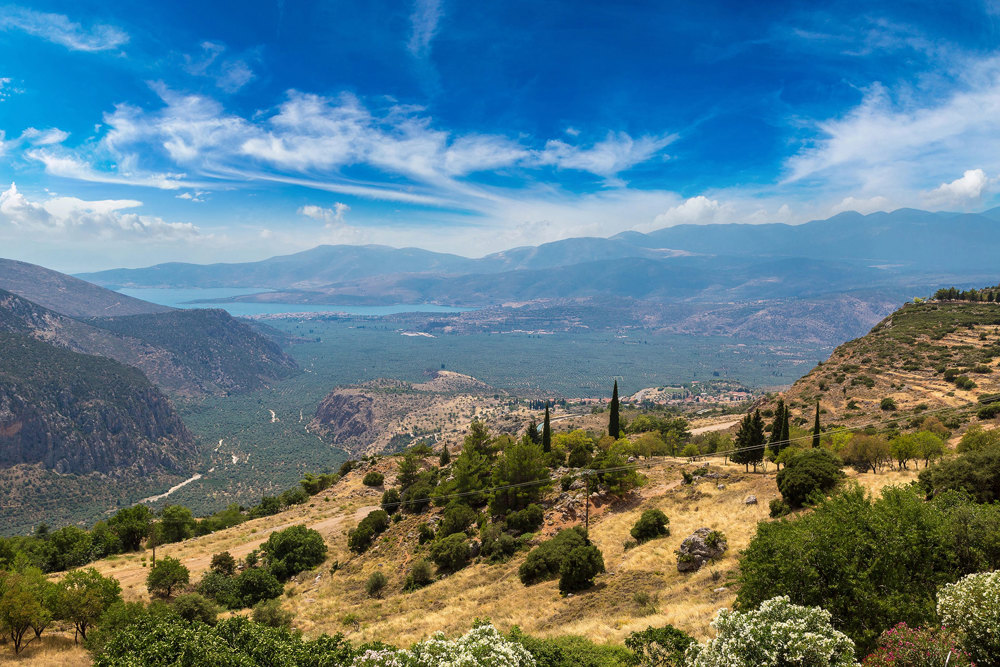
Panoramic view of Amfissa valley with lush greenery, rock hills, and the Gulf of Corinth in the distance

During your visit to Amfissa, you can explore the following sights:

  • The Castle of Salona (Castle of Oria), which occupies the site of the ancient acropolis of Amfissa. Remains of Cyclopean walls are still preserved, along with structures from Greek, Roman, and Byzantine periods. Built partly with ancient materials and later additions from Hellenistic, Byzantine, and Frankish times, the castle preserves the ancient enclosure, the inner gate, the Byzantine Queen’s Tower, and a Frankish church.
  • The Byzantine Church of the Savior, built in the 11th century on a steep slope about 3 km from the town, constructed with limestone masonry.
  • The Metropolitan Church of the Annunciation of the Virgin Mary, located in the town center, renowned for its remarkable frescoes by Spyros Papaloukas.
  • The old tanners’ quarter (Tabakika), known as Harmaena, where the Municipal Art Gallery is located, displaying preparatory drawings (anthivola) for the frescoes of the Metropolitan Church. Many buildings in this district are listed as preserved monuments. A particularly characteristic example is an Ottoman-era building known as “Toulasidi,” along with its contemporary fountain. This monument is an outstanding example of traditional tanning workshops, preserving the medieval character of the area.
  • The Archaeological Museum of Amfissa, housed in the building where the First National Assembly of Eastern Continental Greece was held. The museum features a collection of ancient and modern coins donated by Drosos Kravartogiannis, as well as mosaics, tombs, funerary stelae, inscriptions, and artifacts ranging from the Bronze Age to the Roman period, all originating from the wider region. A highlight is the impressive statue of Persephone from ancient Kallion in the prefecture of Phocis.
  • The Municipal Library of Amfissa, founded in 1957 by the Student Union of Phocians, with a collection of approximately 40,000 volumes, including rare editions.
  • The Panourias House, a fine example of local 18th-century architecture, located opposite the Archaeological Museum. Since April 2019, it has housed the Museum of the Greek Revolution.

Regarding Harmaena, it is worth noting that one of the last fully operating traditional tanning workshops in Greece still functions there.

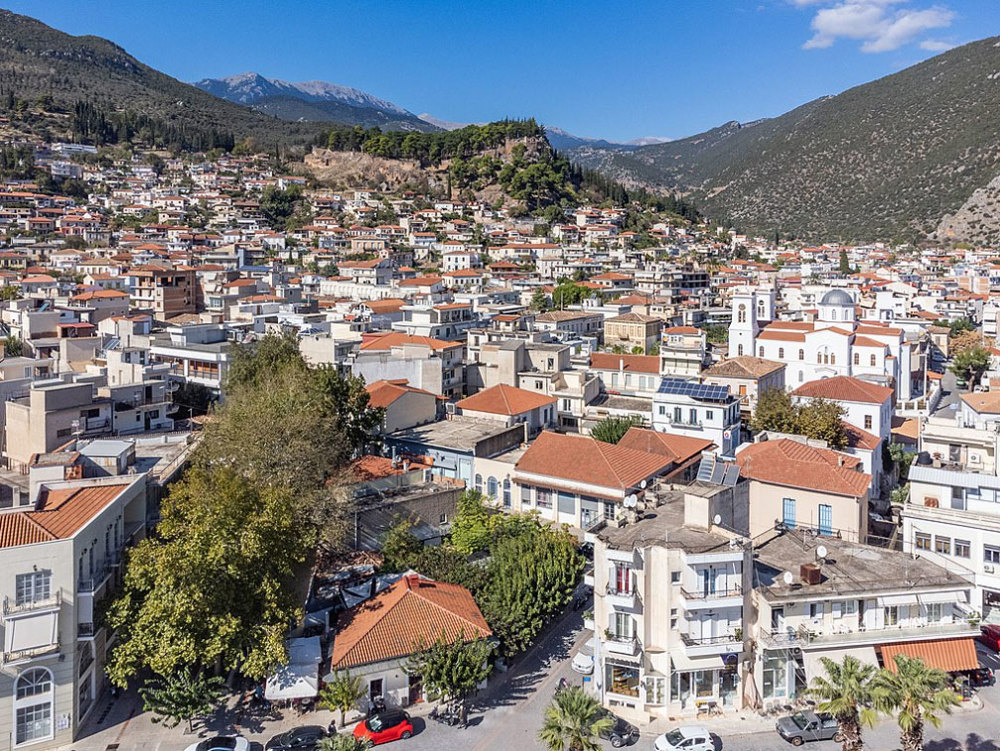
Amfissa’s architecture is of particular interest, with its many traditional mansions and neoclassical buildings, reflecting the prosperity and cultural richness of past eras.